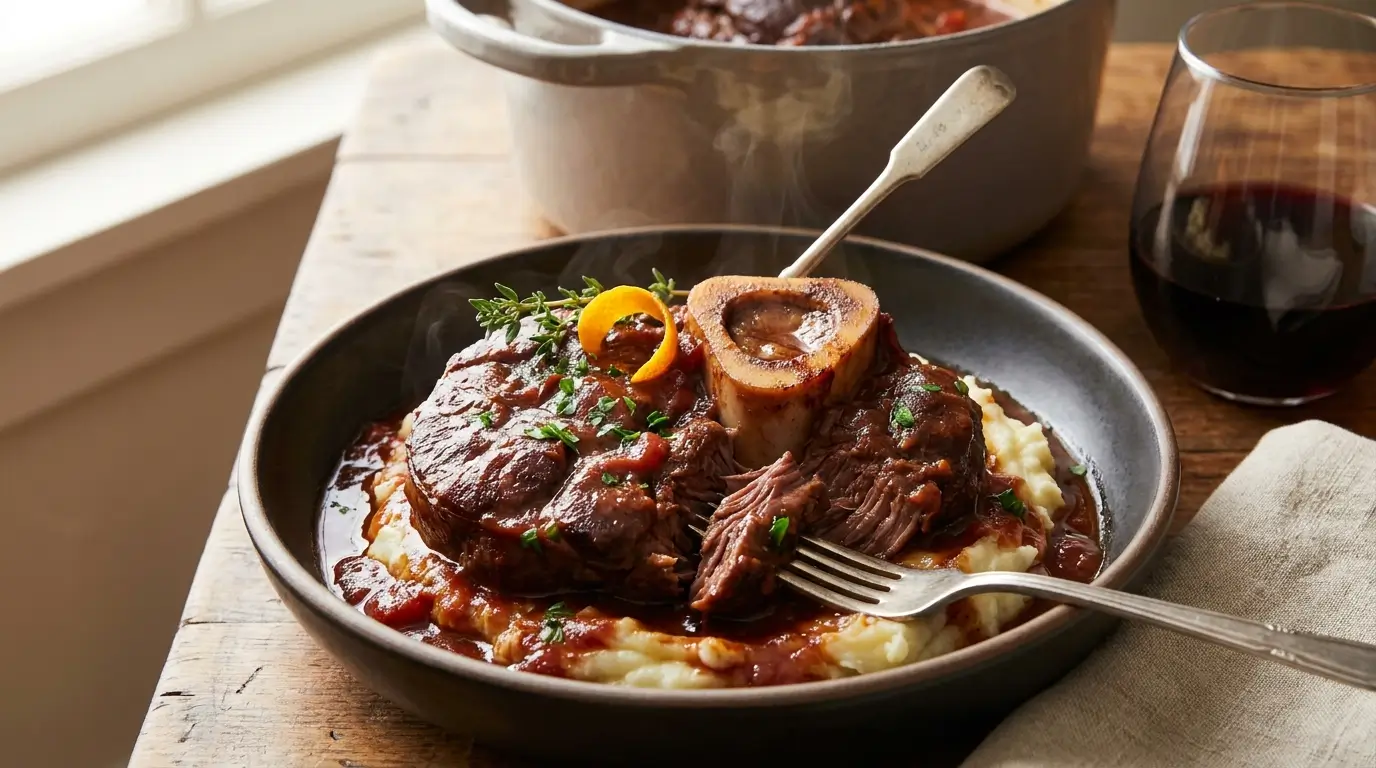
How to Cook the 1 Best Braised Beef Shank: So Tender It Falls Off the Bone
Let me be honest with you — the first time I made beef shank, I pulled it out of the oven after two hours, sliced into it, and nearly broke a fork. It was tough, chewy, and genuinely disappointing. I thought I’d done everything right: seared it, added wine, covered it, baked it. What went wrong?
The answer changed the way I think about braising entirely. And once you understand it, you’ll never ruin a beef shank again.
This is the recipe I wish I’d had that first time — a classic Western braise with red wine, fresh herbs, and deep aromatics, built for a Dutch oven and designed to absolutely melt in your mouth. Whether you’re cooking for a Sunday dinner, impressing guests, or just trying to get the most out of an affordable cut, you’re in the right place.
What You’ll Need — Ingredients
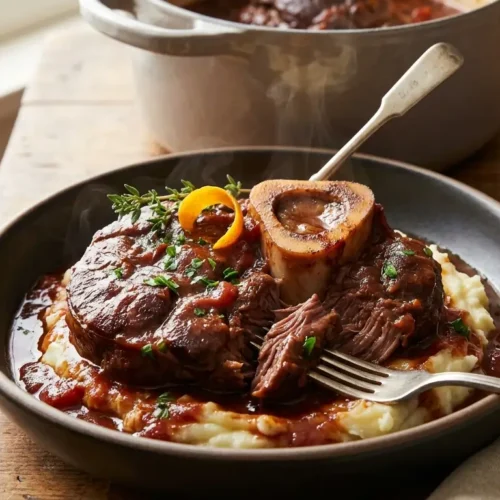
How to Cook the 1 Best Braised Beef Shank: So Tender It Falls Off the Bone
Equipment
- 1 Enameled Cast Iron Dutch Oven 5–7 quart capacity. This is the best investment for even heat distribution and seamless stovetop-to-oven cooking
Ingredients
- 4 pieces beef shanks cross-cut (~1.5 inches thick. Ask your butcher for even cuts)
- 2 tsp Kosher salt For dry brining — more on this below
- 1 tsp black pepper freshly cracked. Don’t use pre-ground
- 3 tbsp Olive oil Or neutral oil with a high smoke point
- 1 large yellow onion diced
- 2 medium carrots chopped
- 3 stalks celery chopped
- 6 cloves garlic smashed. Don’t mince — smashing is better here
- 2 tbsp tomato paste The secret depth builder
- 1½ cups dry red wine Cabernet Sauvignon or Côtes du Rhône
- 2 cups beef stock Low sodium, good quality
- 1 can 14 oz canned whole tomatoes (Crushed by hand)
- 6 sprigs fresh thyme
- 2 sprigs fresh rosemary
- 2 pieces bay leaves
- 1 strip orange peel Optional but absolutely worth it
For Serving: Creamy mashed potatoes, soft polenta, or crusty bread — you want something to soak up that braising liquid, which becomes one of the best sauces you’ll ever taste.
Step-by-Step Instructions
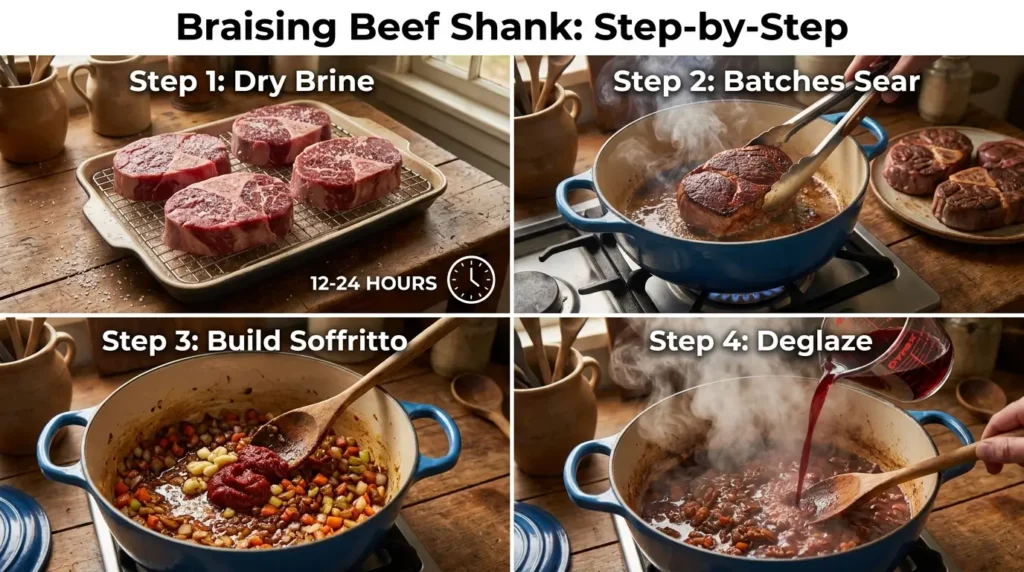
Step 1: Dry Brine the Night Before (Don’t Skip This)
Here’s the first trick most recipes won’t tell you: season your beef shanks generously with kosher salt at least 1 hour before cooking — ideally 12 to 24 hours ahead. Place them uncovered on a rack in the fridge.
This isn’t just about flavor. Salt draws out moisture, which then gets reabsorbed back into the meat along with the dissolved proteins. The result is deeper seasoning all the way through and meat that browns more beautifully. It’s the single biggest upgrade you can make to this recipe.
Step 2: Preheat and Sear
Preheat your oven to 325°F (165°C).
Take your shanks out of the fridge 30 minutes before cooking. Pat them completely dry with paper towels — moisture is the enemy of a good sear. Season with black pepper.
Heat your Dutch oven over high heat until it’s genuinely hot. Add oil. Sear the shanks 2–3 minutes per side until they’re deep mahogany brown. Do this in batches — never crowd the pan. Crowding drops the temperature and you’ll steam the meat instead of searing it, which means no crust, no color, no flavor. Set the seared shanks aside.
Step 3: Build Your Soffritto
Reduce the heat to medium. Add the onion, carrots, and celery to the same Dutch oven (all those browned bits on the bottom are flavor gold — don’t clean the pan). Cook for 7–8 minutes, stirring occasionally, until softened and starting to caramelize.
Add the smashed garlic and cook for another 2 minutes until fragrant. Then add the tomato paste and stir it directly into the vegetables. Let it cook for 2 minutes, letting it slightly darken — this step removes the raw, acidic edge and adds a toasty richness.
Step 4: Deglaze with Wine
Pour in the red wine. It will sizzle dramatically — that’s exactly what you want. Scrape every bit of the browned fond from the bottom of the pot with a wooden spoon. Let the wine reduce by half, about 4–5 minutes. This concentrates the flavor and cooks off the harsh alcohol.
Step 5: Build the Braise
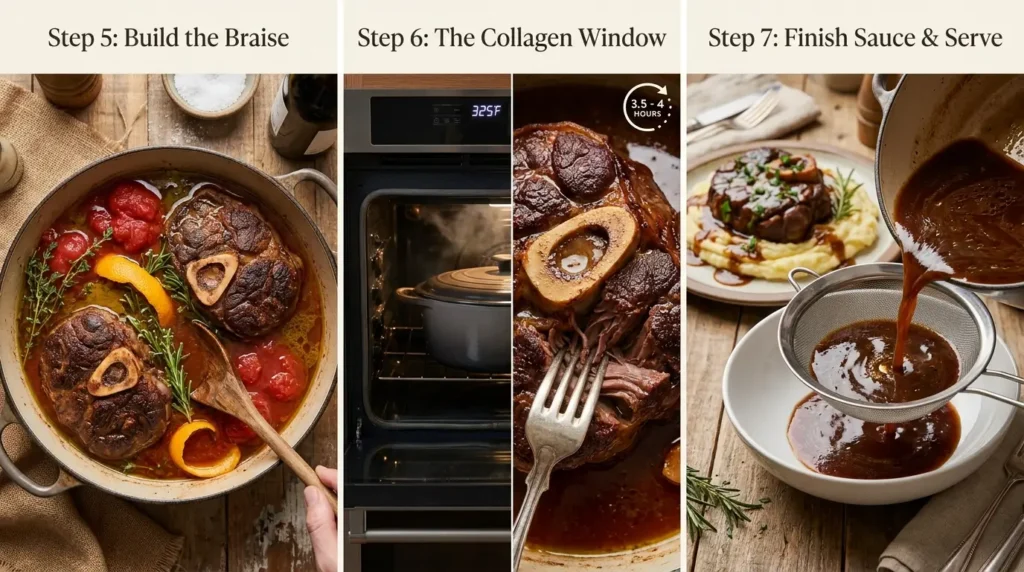
Add the beef stock, hand-crushed tomatoes, thyme, rosemary, bay leaves, and orange peel. Stir to combine. Nestle the seared shanks back into the pot — they should be about two-thirds submerged in liquid.
Bring to a gentle simmer on the stovetop, then cover with the lid and transfer to the oven.
Step 6: The Long Braise — Understanding the Collagen Window
Here’s where the magic (and the mistakes) happen.
Braise at 325°F for 3½ to 4 hours. Check occasionally to make sure the liquid is gently bubbling, not boiling violently.
At the 2-hour mark, your shanks will feel tough if you test them. Don’t panic. Don’t pull them out. This is completely normal and almost everyone makes the mistake of giving up here.
At the 3-hour mark, you’ll start to feel a shift. The meat begins to yield.
At the 3.5 to 4-hour mark — this is the Collagen Window. The tough connective tissue that runs through beef shank has fully converted into silky gelatin, the braising liquid has thickened naturally, and the meat is now so tender it’s literally pulling away from the bone. The marrow in the center of the bone has softened into a buttery, rich treat. This is what you came for.
The shanks are done when a fork slides in with zero resistance and the meat pulls apart easily. If you’re not there yet at 3.5 hours, give it another 30 minutes. Every oven is different.
Step 7: Rest, Skim, and Finish the Sauce
Remove the shanks carefully — they’re fragile now, which is a beautiful problem to have. Set them aside, tented loosely with foil.
Strain the braising liquid through a fine mesh sieve into a saucepan, pressing the vegetables to extract every drop of flavor. Skim the fat from the surface. Simmer the sauce over medium-high heat for 10–15 minutes until it coats the back of a spoon.
Taste it. Adjust salt. A small squeeze of lemon juice at the end brightens everything beautifully.
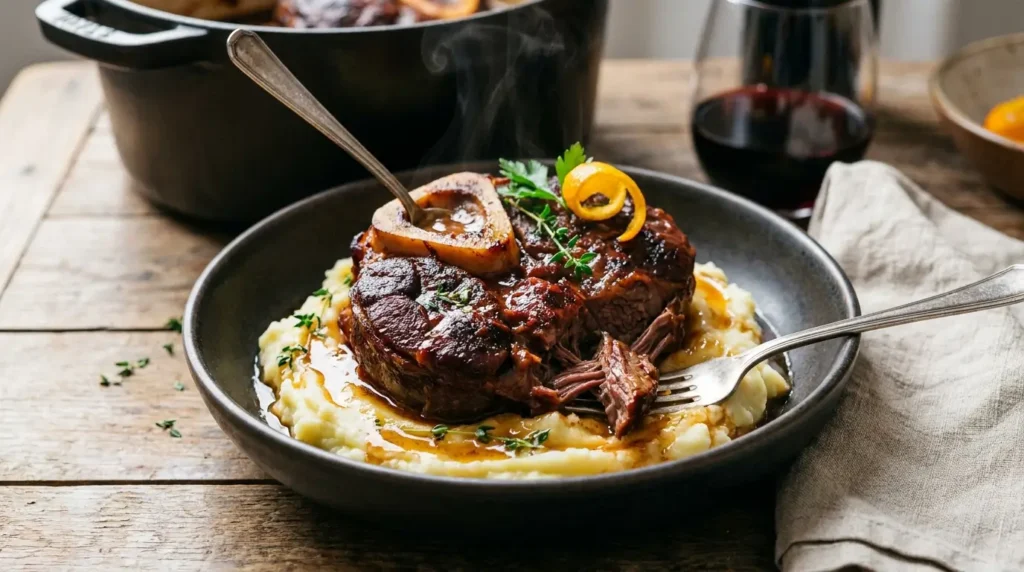
Serve the shanks over your chosen base and spoon that glorious sauce over the top. Don’t forget to scoop out the bone marrow — it’s the chef’s treat.
What Most People Get Wrong with Beef Shank
This is the section I really wanted to write, because so many searches come from people whose shank didn’t turn out right. Here’s why:
They pull it out too early. As explained above, beef shank goes through an awkward tough phase before it becomes tender. Two hours is not enough. Three is borderline. Four is the sweet spot.
They boil it instead of braise it. Your oven temperature matters. Too high and the liquid boils aggressively, tightening the muscle fibers instead of gently dissolving them. Keep it at 325°F and look for a gentle, lazy simmer inside the pot.
They don’t sear properly. A pale, grey sear adds nothing. You need real, deep caramelization — that means a hot pan, dry meat, and patience. Don’t touch the shanks while they’re searing.
They use cheap wine. You don’t need an expensive bottle, but cook with something you’d actually drink. Harsh, overly tannic wine makes harsh, tannic sauce. A $12 bottle of Côtes du Rhône works perfectly.
They skip the tomato paste step. Those two minutes of cooking the paste directly in the pan add an incredible layer of umami depth. Don’t rush past it.
Slow Cooker & Instant Pot Conversion
Slow Cooker: Complete Steps 1–4 in a skillet on your stovetop (the searing and deglazing steps are non-negotiable even for slow cooking). Transfer everything to your slow cooker and cook on LOW for 8–10 hours or HIGH for 5–6 hours. Finish the sauce separately on the stovetop.
Instant Pot / Pressure Cooker: Use the Sauté function for Steps 1–4. Pressure cook on HIGH for 55–65 minutes, followed by a 20-minute natural release. Note: The texture will be slightly different from oven braising — very tender but less of that silky, falling-apart quality you get from the slow collagen conversion.
The oven method will always be the gold standard for flavor and texture. But for weeknights, the Instant Pot version is genuinely excellent.
Frequently Asked Questions
How long does it take to cook a beef shank in the oven?
At 325°F in a covered Dutch oven, plan for 3.5 to 4 hours. Thicker shanks (over 2 inches) may need closer to 4.5 hours. The test is always fork tenderness, not the clock.
Why is my beef shank not tender?
Almost always, the answer is time. Beef shank needs to cross the “Collagen Window” — the point where tough connective tissue converts to gelatin — and that doesn’t happen before the 3-hour mark. The other culprits are too-high heat (boiling instead of braising) and not enough liquid.
Can beef shank be overcooked?
Yes, but it takes real effort. If you braise it for 6+ hours at the right temperature, the meat can start to dry out and become stringy rather than silky. The window of 3.5–4.5 hours is genuinely forgiving. If you’re worried about timing, check it at 3.5 hours and every 30 minutes after.
Do you need to brown shanks before slow cooking?
Technically no, but practically — yes, you should. Browning creates Maillard reaction compounds that add flavor you simply cannot get any other way. It takes 15 extra minutes and makes a significant difference in the final depth of flavor.
Why is beef shank so tough?
Beef shank comes from the leg — one of the hardest-working muscles on the animal. All that movement builds dense muscle fibers and loads of connective tissue (collagen). High-heat, fast cooking methods like grilling or pan-frying can’t break that down. But long, slow, moist heat does — converting collagen into gelatin and turning one of the toughest cuts into one of the most luxurious.
Is beef shank a cheap cut of meat?
Yes — and that’s one of its greatest qualities. It’s typically priced at a fraction of premium cuts like ribeye or short rib, yet when braised properly, it delivers an equally rich, deeply satisfying result. It’s genuinely one of the best value-for-money cuts at the butcher counter.
What spices go well with beef shank?
Beyond the classic thyme, rosemary, and bay leaves in this recipe, beef shank is incredibly versatile. For Moroccan-style, try cumin, coriander, cinnamon, and preserved lemon. For Asian-inspired, go with star anise, soy sauce, ginger, and Shaoxing wine. For a spicier profile, dried chili, smoked paprika, and chipotle all work beautifully.
Is eating beef shank healthy?
Beef shank is rich in protein, zinc, and iron. It’s also naturally high in collagen, which some research suggests supports joint and skin health. The braising method uses relatively little added fat. That said, the cut does contain intramuscular fat and marrow, so it’s best enjoyed as part of a balanced diet rather than an everyday protein.
What is the one ingredient upgrade for better beef stew?
Tomato paste, cooked directly in the pot before adding liquid. It adds a concentrated, savory depth (umami) that you can’t quite identify but absolutely notice when it’s missing. That and a strip of orange peel in the braise — it sounds unusual but adds a brightness that lifts the whole dish.
Pro Tips for the Best Braised Beef Shank
- Tie the shanks. Before searing, tie a piece of butcher’s twine around each shank to keep the meat from falling off the bone mid-braise. You want it to stay intact for presentation.
- Make it a day ahead. Braised beef shank is genuinely better the next day after the flavors have had time to meld overnight in the fridge. Reheat gently on the stovetop with a splash of stock.
- Save that braising liquid. Leftover sauce can be used as a pasta sauce, mixed into risotto, or frozen for your next braise. It’s liquid gold.
- Don’t waste the marrow. Scoop it out with a small spoon and spread it on toast with a pinch of flaky salt. It’s one of the great simple pleasures of cooking.
- Lighter version: Skip the red wine and use all beef stock plus a splash of balsamic vinegar. The result is less rich but still deeply flavorful.
The Bottom Line
Braised beef shank isn’t a complicated recipe — but it is a patient one. Once you understand the science of what’s happening inside that Dutch oven (the collagen converting, the sauce reducing, the flavors building layer by layer), the process stops feeling like guesswork and starts feeling like something you’ve mastered.
The reward is a dish that genuinely competes with anything you’d pay serious money for at a restaurant. Deep, wine-rich, falling-off-the-bone tender, with a sauce you’ll want to drink straight from the pot.
Have you made braised beef shank before? I’d love to hear how it went — drop a comment below with your experience, your variation, or the question I haven’t answered yet. And if this recipe worked for you, share it with someone who still thinks beef shank is “too tough to bother with.” Let’s convert them.
Recommended Tools: A 5–7 quart enameled cast iron Dutch oven is the single best investment for this style of cooking. It distributes heat evenly, holds temperature beautifully, and goes from stovetop to oven without a second thought. Lodge and Le Creuset are both excellent options at different price points.
|“If you tried this, tag us on Facebook or save it to your Pinterest board!”